Math Ambassadors: Zenaida Rodriguez From the South Texas All Abilities Center
Eagle Pass, Texas — a community on the Rio Grande near the U.S.-Mexico border — is a city shaped by its rich cultural history.
For Zenaida Rodriguez, it’s also the place she calls home. She’s the mission director of the South Texas All Abilities Center (STAAC), a nonprofit focused on improving the quality of life for people with disabilities throughout the region. Rodriguez, who understands how limited opportunities can be for the people she serves, is driven to create experiences that center on continued learning and connection. This includes a new program, supported by the Simons Foundation’s Infinite Sums initiative, that invites individuals and their families to explore math in meaningful ways.
Rodriguez’s journey in science and math engagement started with the 2024 total eclipse. While working for the city of Eagle Pass, she organized a celebration that invited people to explore the science and wonder of the celestial phenomenon.
Following that program’s success, she helped conceptualize a paint-by-numbers “Mural Matemática” that brought people together to experience math by picking up a paintbrush and solving equations. Now a permanent fixture in downtown Eagle Pass, the mural serves as a point of local pride and a lasting example of how learning, creativity and community can come together.
We recently spoke with Rodriguez about her community’s journey with math and science, the meaningful opportunities for learning and connection that have emerged and how those efforts are inspiring a new inclusive children’s museum in downtown Eagle Pass.
The conversation below has been edited for clarity and brevity.
Thank you for speaking with us, Zenaida! Can you start by telling us more about your work with the South Texas All Abilities Center?
We’re a nonprofit that’s about three years old and serves individuals with disabilities of all ages. Our primary mission is to identify the barriers that individuals with disabilities face in our community and create programs and resources to help address them. The goal is to enhance their quality of life by connecting them to essential resources like therapies and educational and social programs, and we’ve also been creating many adaptive offerings because we live in a rural area.
We live in Maverick County, which is one of the lowest-income counties in Texas. So you could say we’re already an underserved community, and the disabled community within it is even more underserved.
In Texas, the law is that special education for individuals with disabilities is state-funded until the age of 21. And once you age out of school, there’s not really anything for you. One of the only options at that point is an adult daycare. I once visited one to drop off flyers, and participants kept talking about “graduating,” even though there’s no such milestone — they just see their peers heading off to college after high school and assume the same path also applies to them. That stuck with me. There’s so much more they could be learning.
And how have these realities shaped the way STAAC has approached math programming as part of your partnership with Infinite Sums?
What we’ve learned is that many individuals just want to learn everyday life skills while connecting with their peers, so we’ve really leaned into that as part of our approach to math.
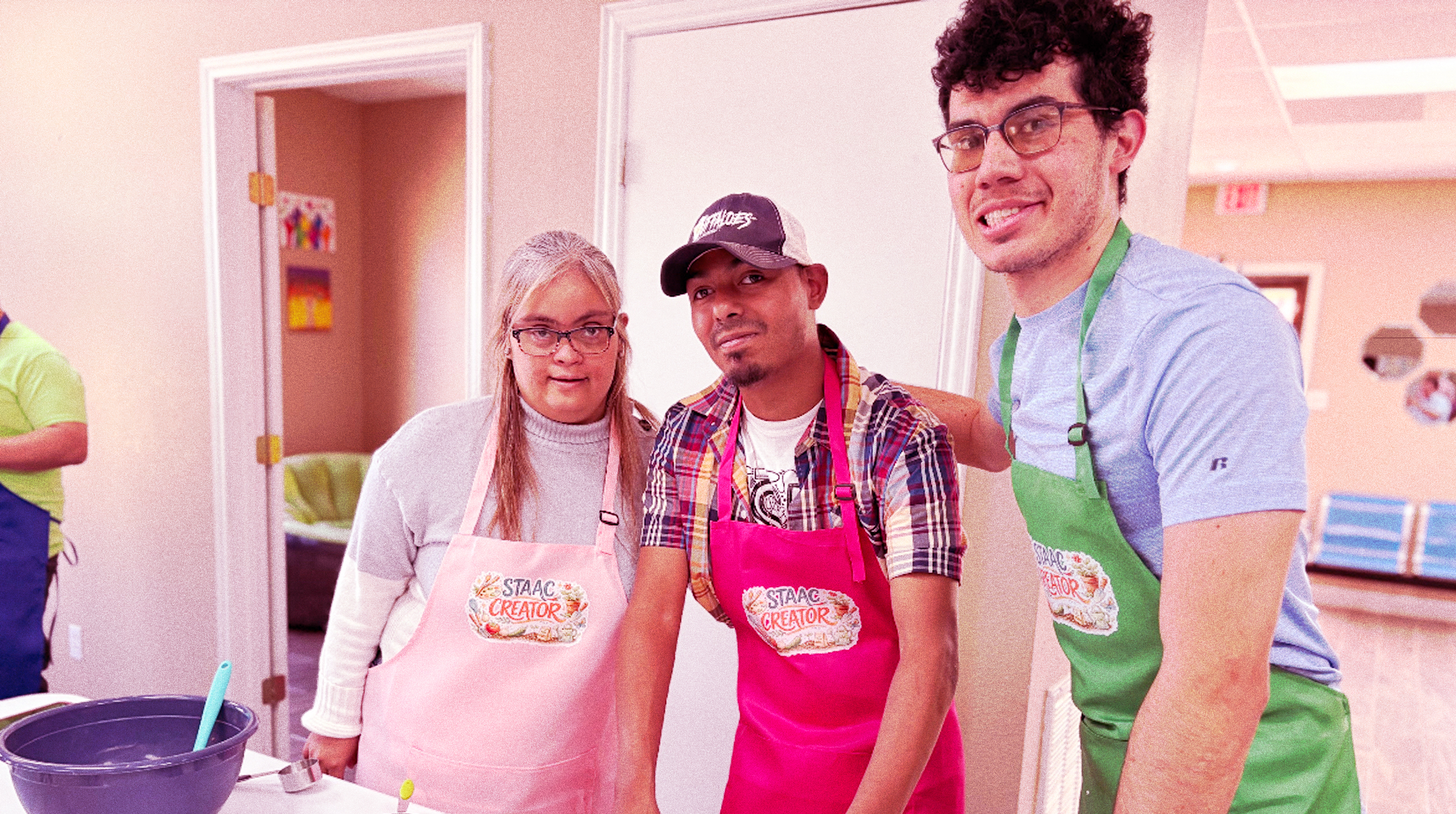
One of the most popular things we created is a kitchen skills program that launched on Thanksgiving. We wanted to give participants the opportunity to explore and experience all of the math in the kitchen — from measurements, portions, oven temperatures and cook time. Everyone learned how to make a simple pie, an appetizer and centerpieces, and we celebrated by awarding certificates of achievement and inviting their families to enjoy the dinner they had prepared themselves. We’ve heard time and time again, “I never thought I would be able to do this!”
For Pi Day, we continued the kitchen skills class — we made pizzas, we made pies and we taught them the math behind it all. We made recipe books of everything they made and gave them H-E-B gift cards, which is a grocery chain here in Texas. We learned from their families that they immediately went to H-E-B to make that food again at home. We’ve since run the class again in June with a barbecue bash for adults 18 and up, a weeklong class that started with planning a party — budgeting for how many guests, what food to make — and ended with a math-inspired mixology class and a family celebration where participants were the ones greeting guests and making the drinks.
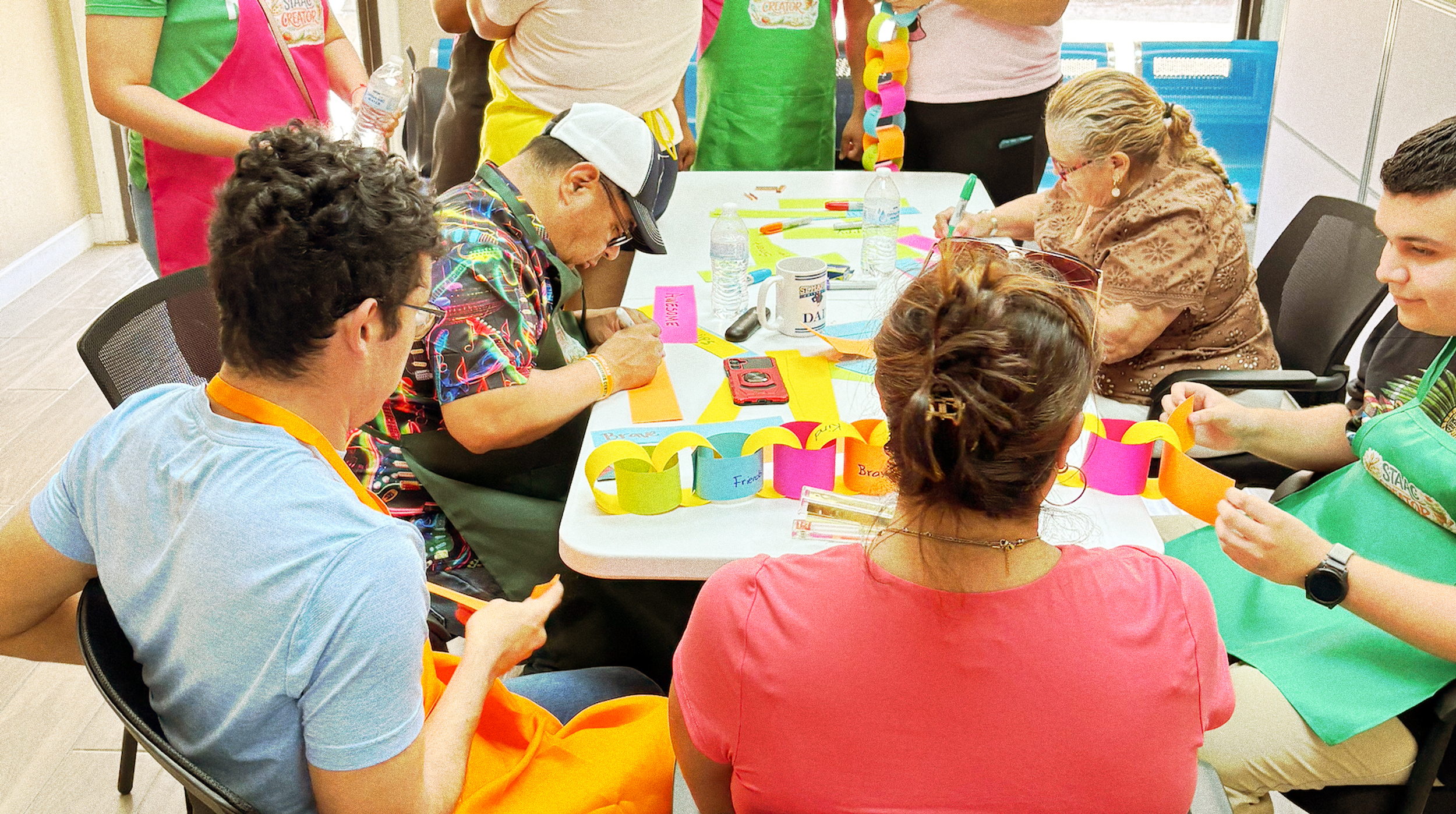
Our most recent event was Infinity Day, where we taught the concept of infinity through creative activities such as painting and building infinity cubes. The favorite activity was a paper chain we created together to help express how a circle or a chain can just go on forever. For each link, participants wrote words that best represent them such as brave, respectful, friendly and strong. It’s actually still up in our space as decoration because we want to keep adding to it and let it go forever.
With all of these programs rooted in making math feel personal and approachable, we're curious: What has your own relationship with math been like throughout your life? And how do you feel about being a math ambassador?
I do like math — science is a different story. I always say don’t talk to me about science, I hate it [laughs]. But math, as a kid, I actually tested into the gifted and talented program when I was in kindergarten, and I was always a really fast learner as a student. I was in a number sense program in elementary school. But I did start slacking off once letters got involved, and it started getting really tricky.
But the way I see it now is so different, and it really is everywhere. I’m not going to say I’m a math genius, but I feel like I come up with some interesting ideas. It’s almost like a puzzle to figure out because everything has math; it’s just about taking the time to identify those underlying components. It adds an educational tool to what you were already going to do anyway, and I have truly enjoyed learning that aspect. It really is everywhere.
I personally decided to keep doing this work after learning that young women, especially, give up on math very early on, and I’ve always been about girl power. So once I learned that, I decided that we’re not going to let that stigma happen here.
What have you learned by developing celebrations around math for your community?
The main thing we’ve learned is that you can really find educational components in so many places. When I worked for the city, the question was how to create something that would attract the masses. But in this more niche space with STAAC, it’s about making math feel truly meaningful — helping people improve and learn in a way that has a lasting impact on their lives.
I’m really proud that we’ve been able to teach concepts like pi and infinity in a way that resonates with people. And I really look forward to continuing that with the kitchen skills classes—normally, you’d just get a recipe, but now we can add that mathematical explanation to it, and they’re learning even more in the process.
Can you tell us a bit more about what the future of this work looks like for STAAC and the broader Eagle Pass community?
Our next math event will be a gardening day, planting in Fibonacci style — one cup of soil with one seed, two drops of water, three minutes of sunlight, following the sequence from there. We’re planning one big community garden that will talk about math in nature, along with take-home kits so families can keep practicing at home.
All of this excitement around math and science in our community is feeding into the new inclusive children’s museum, which will be located in a building that was historically an H-E-B grocery store downtown. I actually found old photos of what the space looked like back when it was H-E-B and sent them over to H-E-B and told them all about our plans. They loved it so much that they donated in support of the museum! We’ve even had local contractors come on board who were willing to do the work for free.
The exhibits inside will be inspired by this community: A mining company is contributing to a mining experience, our local waterworks company wants a water exhibit and local banks want to build a little vault and a math experience. We loved that idea because, as a border town, currency exchange is math that people use every day without even realizing it. We’re also hoping to have a rotating art exhibit, starting with a digital or paper version of our original paint-by-numbers Mural Matemática from downtown.
I’m always excited to keep learning and to bring what we learn back here, because our goal is really just to improve the quality of life for our community — and they’re here for it. They’ve grown to expect these things from us now. So it’s good. We’re here for it, too!