
Math Ambassadors: Artist Jiabao Li
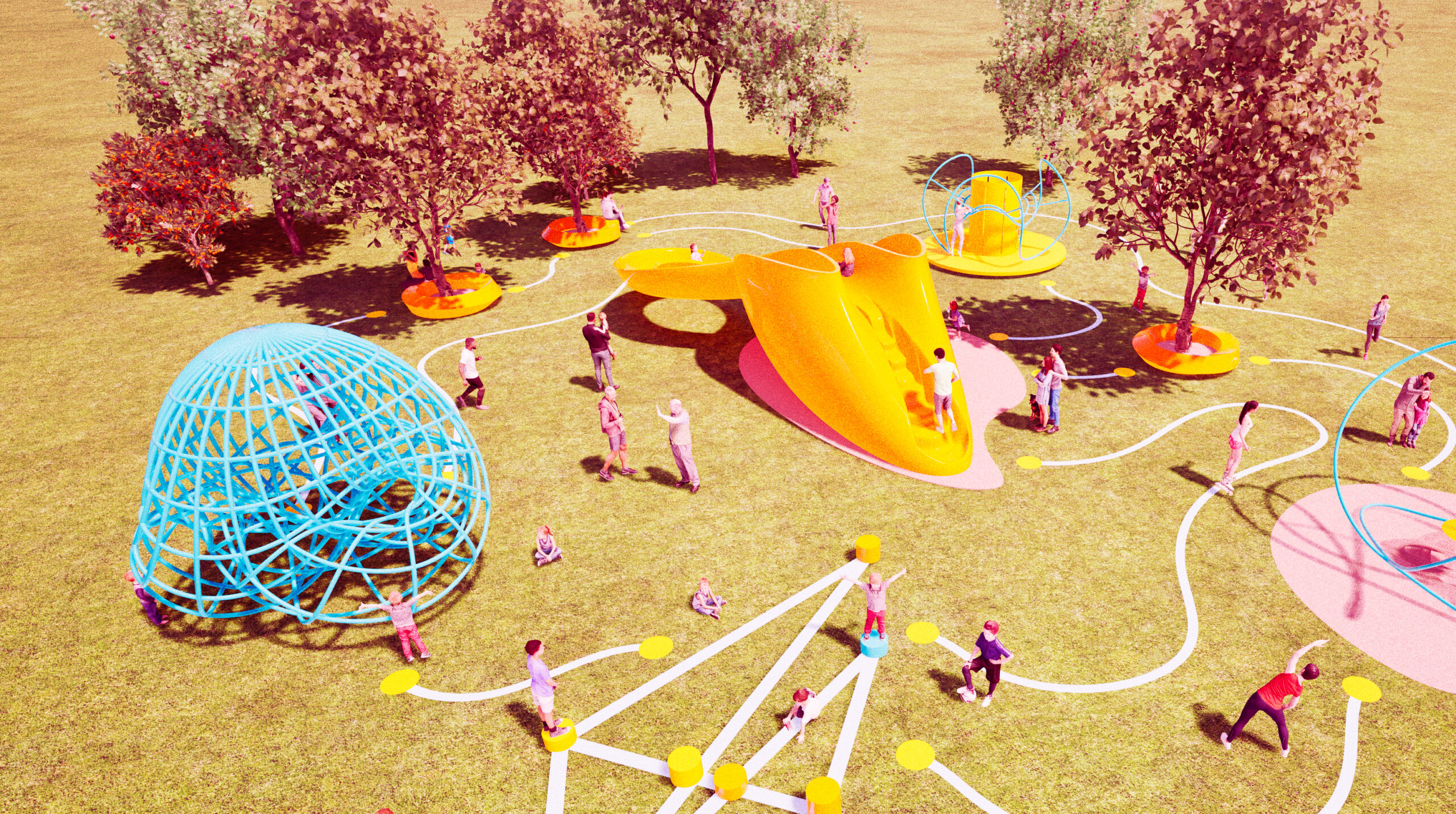
Jiabao Li is an Austin, Texas–based interdisciplinary artist whose work explores science, perception and embodied experience. In collaboration with mathematician Fumiko Futamura and the Fusebox Festival’s Ron Berry, Li is developing Math Playground, a series of climbable sculptures based on complex mathematical models like the Boy’s surface, the Klein bottle and the zoetrope. The project will transform abstract mathematical concepts into playful, physical structures that both children and adults can explore with their bodies. Math Playground is one of five selected projects in the Simons Foundation’s most recent Triangle Program, which supports artists, scientists and arts organizations in producing new work.
In this conversation, Li reflects on her early experiences in competitive mathematics, her friendship-turned-collaboration with Futamura and her framework for meaningful art-science partnerships. She shares how having a newborn has influenced her thinking around play and learning, and why she believes the next generation deserves a warmer, more embodied relationship with math.
The transcript below has been edited for clarity and brevity.
Thank you for speaking with us! Tell me about an early memory of math. How did it make an impression on you as a young person?
I’d describe my early math memories as a combination of challenging, exciting, intimidating — and maybe a little traumatic [laughs]. I grew up in Shenyang, China. In middle and high school, I was enrolled in a specialized math class. It was very advanced; we studied university-level math at a young age — topics like calculus and linear algebra — and it was all really hard. All the students competed in both the Chinese and American Math Olympiads. Overall, it was intimidating, sometimes not fun, and I found it to be the hardest of all the subjects. We spent about 40 percent of our time studying math; it was a major academic focus.
But at the same time, I loved it. I loved what a twister of the mind it is. Problem-solving does so much for your brain; it’s like exercising your brain, a brain workout.
Art is at the forefront of your work, and science informs so much of what you do. How does math play into your art practice?
Before I began collaborating with Fumiko, math was never front and center. I had been more focused on biology. Working with Fumiko opened a whole new world for me — I see math in different ways. Fumiko and I became friends first, and then we became collaborators. Because we’ve become friends, we don’t feel intimidated; we can be naïve together. No idea is too basic, and in this way, strong ideas can come through. I think also the structure of Open Interval is key, having a trio. When it’s just an artist and scientist in the mix, everybody’s busy, and sometimes it can be difficult to find time to meet or make space for all the ideas to form. This program really helped make space for that.
How did you and Fumiko establish comfort with each other?
We needed to pause to learn each other’s words and terminology first. Our first conversations really felt like a lecture. It was like I was taking her mathematics class. She sent me her course material and her slides, and she dropped off a giant box of books at my house related to math, art and art history. I learned what she specialized in, and that there are so many different types of math that are inspiring.
Which of her research topics were you attracted to?
At first, I was drawn to perspective because so much of my work is about changing perception, and perspective is related to that. Fumiko has taught me a lot about the perceptual magic of vantage points in historical paintings, for example. She is an expert on this. She and I talk a lot about space-time travel as you move into the fourth dimension, as well.
Tell me about the process of your collaboration. What do the two of you do when you get together?
Early on, we visited the Museum of Illusions together, because our work deals with perspectives and visual illusions. That trip was a turning point for us. A normal visit might take 30 minutes, but we were there for four or five hours brainstorming together. Since then, we’ve visited other museums, or I would go to her office. We’ve made digital and physical models to experiment and see how different complex math models might work on a large scale. For example, we made a pendulum swing to test a possible swing set. We filled it with sand, and we made a mess in her office; there was sand everywhere! We even grabbed a physics professor from another floor to try to figure out the physics of the swing. Looking at different models in her office is so interesting because things like tessellations, crochets and the parabolic make more sense when they have physical forms.
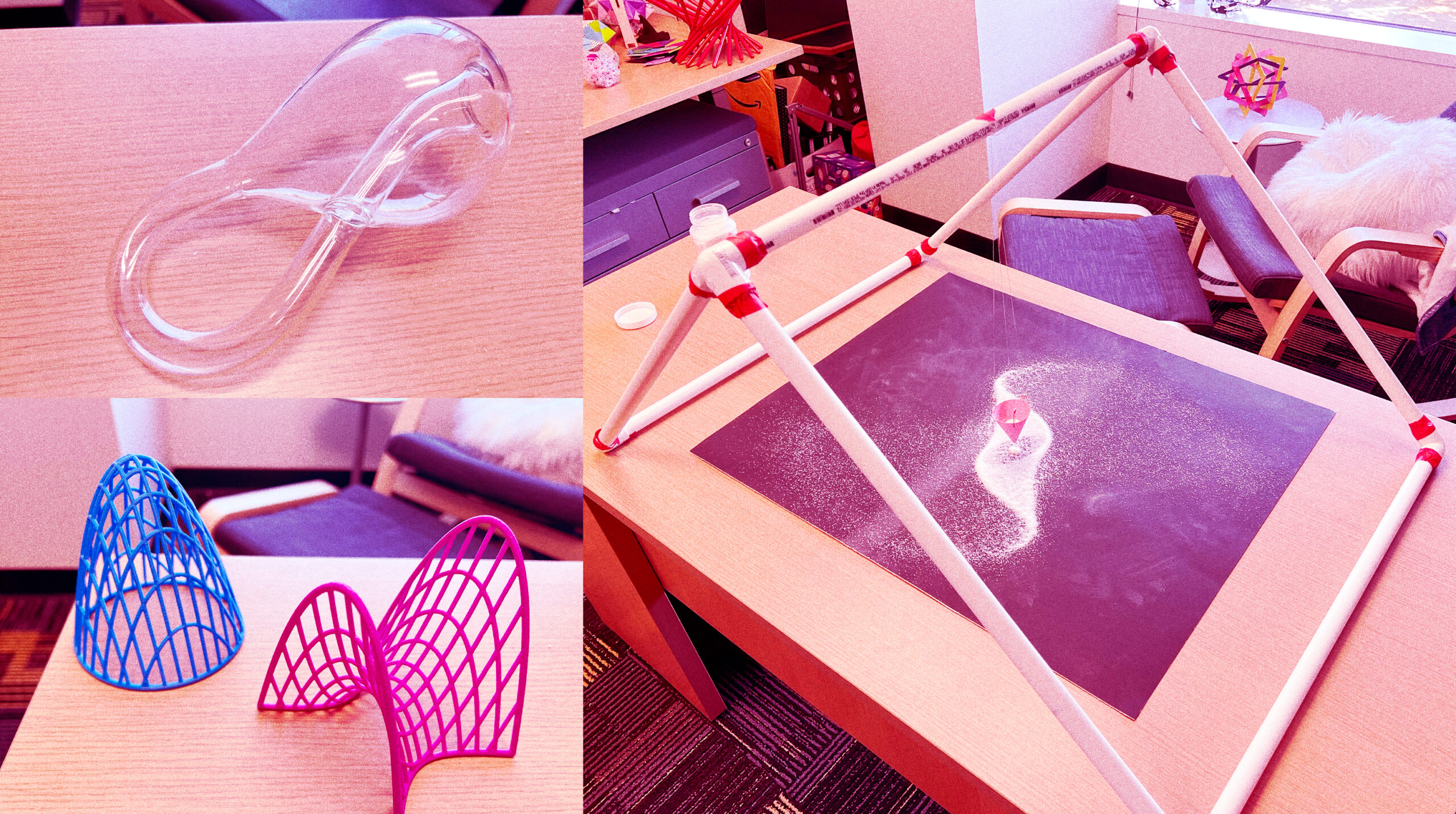
These days, she comes to my house every week. I have a newborn baby, so being at home is important. Often, I make an assignment for each of us to think about three “what if?” questions so that every week when we meet, we can raise three “what if?” ideas that can be anything, even something crazy. It’s a good way to brainstorm. We also share the things that inspire us separately — we keep lists of things that catch our interest and talk about them together to see if anything sparkles.
You have a special way of thinking about art and science collaboration. Can you tell us more?
Yes — I’ve developed a framework for art-science collaboration that I call OTPCC. It stands for Open, Time, Process, Curiosity and Crediting. I applied this to my collaboration with Fumiko right away. It starts by being open to each other’s work. Fumiko and I are very open and receptive to each other’s worlds. I see her as a whole person and appreciate her different identities as a mathematician, as an artist in her own right and as a Japanese American woman. Next is acknowledging that collaboration takes time. It’s great that the Open Interval program gave us half a year to openly explore. We didn’t have to land on something specific right away, and it really takes time to learn all this math. Next, we are process-driven. The process is part of the work, not just the outcome. We enjoy our process so much. Given the option, we would repeat the Open Interval program another three or four times. We lead with curiosity about each other’s work. This goes deeper than science communication, but makes spaces to ask weird questions that scientists might never think of. Finally, we share credit. The works we conceive together from the outset reflect a pure collaboration and need to be credited as such.
That’s a beautiful philosophy! Ultimately, you arrived at the idea for the Math Playground. Tell me about that.
Well, I just had a baby, and there’s so much play in my life. Plus, when I was young, math was so tedious and intimidating and traumatic, but learning from Fumiko is so playful. So, what if others could literally play with math — climb on it, move around it, think about it differently? Math models like topology are ideas I didn’t have access to when I competed in the Olympiads, but they are opening a whole world of interesting math for me, and they are really good candidates for a slide or a climbing structure.
We have a bunch of ideas that we developed in parallel. We’ll start with a model, test out how it could work or how it could fail. Then we 3D-printed the models, and even added little figures standing there and sliding down.
It’s exciting to see you thinking about a more embodied experience for the next generation of math-curious people. How do you see something like the Math Playground impacting people?
For kids, they come, they see an interesting playground, they play on it. That’s a conversation starter, and it’s an early exposure moment that could plant some seed of interest around math, math models or math thinking that has a longer-term effect. For adults, it’s a series of sculptures that you can climb on and you can play with. Beyond interacting, there will be signage that talks about math models to help you understand more. These are complicated ideas that even mathematicians have a hard time wrapping their minds around, like the Boy’s surface. It’s so hard to understand what’s going on with these in-and-out tunnel structures and non-orientable surfaces, but if I can climb in and out, I really can understand it better.
So both kids and adults can get something meaningful out of it.
Yeah, and as a sculpture, it will stand as a work of public art in the city. Playing on it adds something more — it gives you this warm, bodily feeling with math. It’s larger than life, not just theoretical.
That’s amazing. That’s not something that most of us have had.
Right, we never learned math that way. It’s so abstract to know math through numbers alone. I wish I’d had a playground like this growing up.
This interview is part of our Math Ambassadors series, which aims to highlight the diverse range of people leading math engagement work supported by Infinite Sums.